As they make final preparations, cities hosting official World Cup matches and fan zones hope Washington’s once-in-a-generation opportunity will have lasting benefits.
Story by Jennifer Krazit
Illustrations by The Griffin Agency
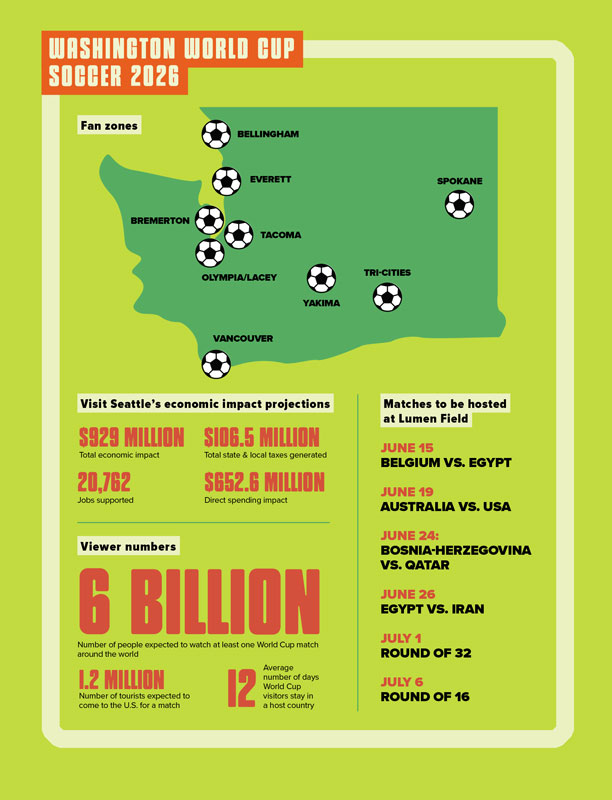
When the national soccer teams from Belgium and Egypt face off at Lumen Field on June 15, it will signify the culmination of years of effort to bring the World Cup to Washington and a thrilling opportunity to put Seattle—and the whole state—on the world stage.
Seattle is one of 16 cities across the United States, Mexico, and Canada that are hosting matches in the 2026 FIFA World Cup. The tournament, which consists of 48 teams playing 104 matches over the course of about a month this summer, will be watched by billions of people around the world. More than a million people will travel to the U.S. to watch matches in person.
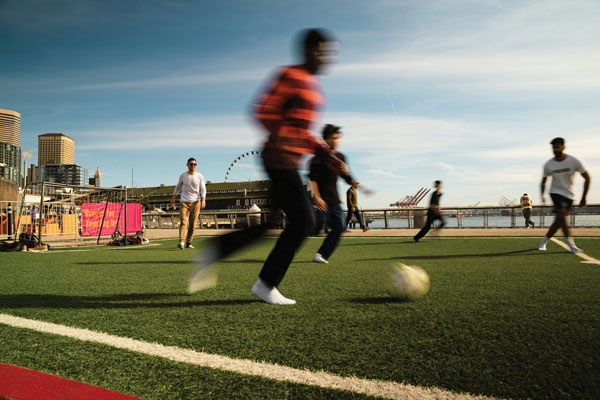
A pickup match on soccer fields that are part of Seattle’s newly renovated waterfront (Photograph by Wildfire 1775 / pexels.com)
No city in Washington will experience the same influx of tourists as Seattle (and all the benefits and burdens that will come along with them). But many cities throughout the state will have their own World Cup moments.
“Seattle’s local organizing committee has done an incredible job of saying, ‘This is not just going to be Seattle’s moment with the World Cup. This is going to be the entire state’s moment,’” says Spokane City Administrator Alexander Scott, who has been leading World Cup planning for his city.
To ensure just that, SeattleFWC26, the local organizing committee, is partnering with nine cities across the state to host official FIFA-branded game-day events called fan zones. Additionally, Renton and Spokane were approved as potential base camps, or temporary home bases for competing teams. These opportunities offer Washington cities a rare chance to welcome visitors from around the world and participate in a global event in ways that are unique to their local communities.
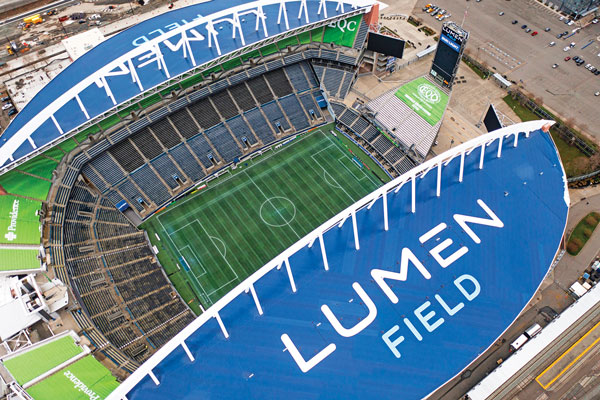
Center circle in Seattle (Photograph by Joshua Lehew / shutterstock.com)
For city leaders in Seattle, this World Cup is a long time coming. Planning officially began the moment Seattle was named a host city in 2022. But in reality, preparations have been in the works much longer, according to Seattle Deputy Mayor Brian Surratt, who says the city had been talking about hosting a World Cup and putting together its bid to host for years. “I would make the argument that it goes back to the love affair that we have with the Sounders and the construction of Lumen Field. That stadium does not get built without the support of soccer fans across the state,” says Surratt, pointing out that it was designed to host not just football and soccer games, but also major events like a World Cup.
These are signals to the world and, frankly, to ourselves that we can do big things. We can invest in ourselves.
– Brian Surratt, Seattle Deputy Mayor
“Now, 25-plus years later, the vision has been realized to have the world’s eyes on Seattle,” he adds.
Knowing there would be a spotlight on Seattle meant the city needed to invest in some basic capital improvements to make the downtown area more accessible, including right-of-way improvements, Americans with Disability Act improvements, and additional signage. It also meant prioritizing larger projects that were already in progress to ensure they’d be completed before the big event. That included finishing an $800 million renovation of the waterfront; an overhaul of downtown’s Westlake Park, where watch parties will be held; and upgrades to and restoration of miles of protected greenway trails and parks called the Elliott Bay Connections project.
Although the city looks forward to showing off these renovations, it’s not focusing on downtown alone. Using a distributed festival model, the city’s Office of Arts & Culture, Department of Neighborhoods, and Parks and Recreation is working with neighborhoods citywide to organize watch parties and smaller-scale celebrations in every corner of the city.
As it happens, city leaders got a bit of a test run for hosting an event of this magnitude in February with a Super Bowl championship parade for the Seattle Seahawks.
“Several hundred thousand people had a good time, and all of our operations—fire, police, transportation, utilities—were in place to make that parade safe, fun, and memorable,” says Surratt.
Whether visitors end up spending the off days downtown, exploring other Seattle neighborhoods, or heading out to the mountains or the San Juan Islands, Surratt says this is an opportunity for the region to shine.
“It’s not just six matches that happen to be here,” he says. “These are signals to the world and, frankly, to ourselves that we can do big things. We can invest in ourselves.”
Camping out in Spokane
Although it’s almost 300 miles from downtown Seattle, Spokane will be a hub of World Cup activity all on its own.
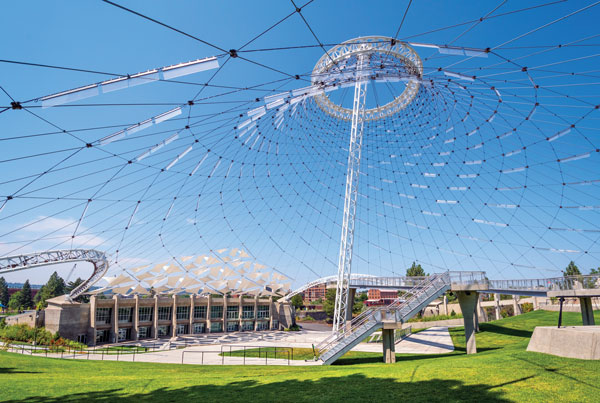
As a designated fan zone, Spokane will host major FIFA-branded watch parties at the Gesa Pavilion in Riverfront Park. (Photograph by Kirk Fisher / shutterstock.com)
Team Egypt selected Spokane as its official team base camp, meaning its players will make Spokane their home away from home throughout the tournament and train at Gonzaga University’s Luger Field. One of its members, Liverpool FC forward Mohamed Salah, happens to be one of the most popular soccer players in the world.
Beyond one training session that will be open to the public, little is known about whether the team will make public appearances. But if history is a guide, throngs of the team’s fans will make their way to Spokane just for a chance to be in their heroes’ orbit.
We really wanted to make sure that we could take this fan zone designation and have it add value to the rest of the community.
– Alexander Scott, Spokane City Administrator
“The city has a big role to play in terms of event security and logistics, and we’ll be working with the team on securing their travel and making sure that everything they need is provided,” City Administrator Alexander Scott says.
In addition to being a base camp, Spokane is a designated fan zone and will host major FIFA-branded watch parties at the Gesa Pavilion in Riverfront Park. However, the city wants to make sure local businesses get to reap the economic benefits of hosting their own parties.
“We really wanted to make sure that we could take this fan zone designation and have it add value to the rest of the community,” says Scott. “We don’t want to cannibalize from neighborhood bars and restaurants that hopefully will be seeing big boosts this summer.”
In partnership with the county, local destination marketing organization Visit Spokane, and event organizer Spokane Sports, the city developed a Summer of Soccer branding campaign, which will allow local businesses to decorate and market their own World Cup festivities throughout the tournament, drawing in fans to watch the dozens of games that will air over several weeks. In addition to driving business, Scott says the city hopes its World Cup events will leave a lasting legacy by shining a spotlight on the sport of soccer. Spokane has a professional men’s team (the Spokane Velocity) and women’s team (the Spokane Zephyr). Local colleges Gonzaga University and Whitworth University have successful collegiate programs. And the area has robust youth soccer programs and hosts a large multistate tournament each year.
Spokane Summer of Soccer logo (Logo courtesy of Visit Spokane)
“Aside from all the benefits you might think of, we want to see what can happen with the game of soccer here,” he says. “How can interest at the youth level be turned into interest in showing up to a Velocity or Zephyr match? How can showing up in town for a prep soccer tournament turn into a scholarship offer at one of our local colleges or universities?”
Mini fairs in the Tri-Cities
The Tri-Cities will host official fan zone activities for four of the six Seattle-based games at Pasco’s Gesa Stadium, home to Minor League Baseball’s Tri-City Dust Devils. Three games will be shown on the big screen inside the stadium, and one will be shown just outside the stadium.
Meanwhile, the whole area will have a mini-festival vibe: live bands; a soccer video game tournament; booths for arts, crafts, and merchandise; and a dedicated kid zone with games and soccer drills led by local high school teams.
The choice of venue, which can seat more than 3,600, means the city won’t have to deal with logistics like restrooms or food. But that doesn’t mean pulling off the event will be a cakewalk. The games come right in the middle of an already packed time of year.
“We do a huge Cinco de Mayo event every year, and then we have a big Fourth of July event,” says Pasco Recreation Manager Brent Kubalek, “so it’s a large lift to add these events into the mix.”
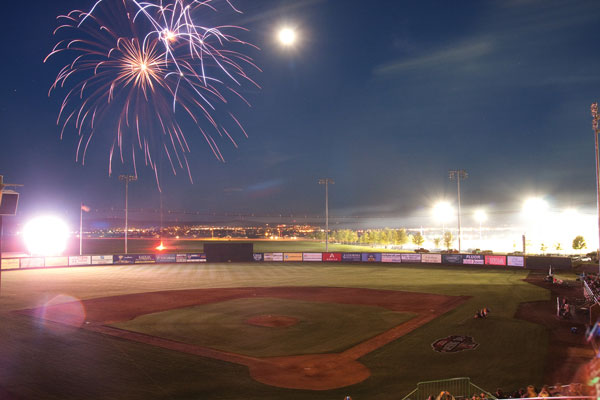
The 2025 Fourth of July fireworks display at Pasco’s Gesa Stadium, where three World Cup games will be broadcast on the venue’s big screen this summer. (Photograph courtesy of Visit Tri-Cities)
Funding has been a joint effort: The Pasco City Council committed some of its budget for the festivities, with additional support from corporate sponsors and Visit Tri-Cities, the region’s destination marketing organization. The city continues to look for other funding sources, including applying to its Lodging Tax Advisory Committee for funds to help promote the events. Meanwhile, the police department applied for grant funds through SeattleFWC26 to help defray added security costs.
Three of the games midday kickoffs. We could have 400 people there, or we could have 4,000 people, We don’t have any history to go off of.
– Brent Kubalek, Pasco Recreation Manager
One big unknown? Turnout. It’s hard to know what to expect, especially because the games aren’t happening locally and aren’t centered around typical evening or weekend entertainment schedules.
“Three of the games have midday kickoffs,” says Kubalek. “What kind of crowd are you going to draw Friday at noon or Wednesday at one o’clock? That’s a big question mark. We could have 400 people there, or we could have 4,000 people. We don’t have any history to go off of.”
Still, the city is hopeful that people who live in the region will be enthused about coming together to share a World Cup experience of their own and that some global travelers will tour around the state.
We’re looking forward to what we hope is a good and fun event for not only everybody here in the Tri-Cities, but people in surrounding areas and visitors, too,” says Kubalek.
Ready in Redmond
About 17 miles east of Lumen Field, Redmond has had an eye on the opportunities the World Cup could bring to the region since Seattle was announced as a host city.
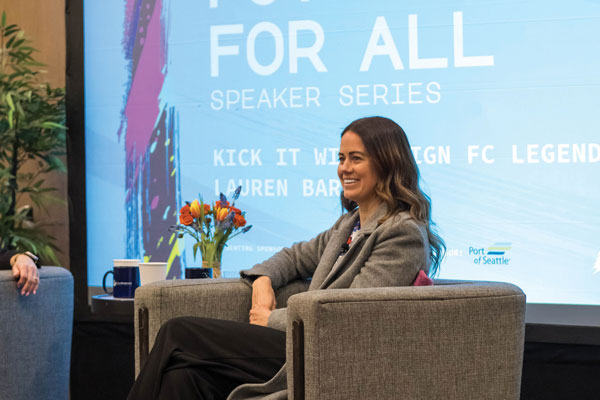
Seattle Reign FC soccer star Lauren Barnes speaks at Redmond’s Fútbol for All Speaker Series. (Photograph courtesy of Jane Gershovich)
“We’ve known the World Cup was coming for years and that hopefully the light rail station in Redmond was going to connect to Seattle by then, so there was this amazing opportunity for Redmond to show off to the world,” says Mayor Angela Birney.
The Crosslake Connection—the world’s first light rail on a floating bridge—opened in late March, making it that much easier for fans to get between Redmond and the center of the action in downtown Seattle.
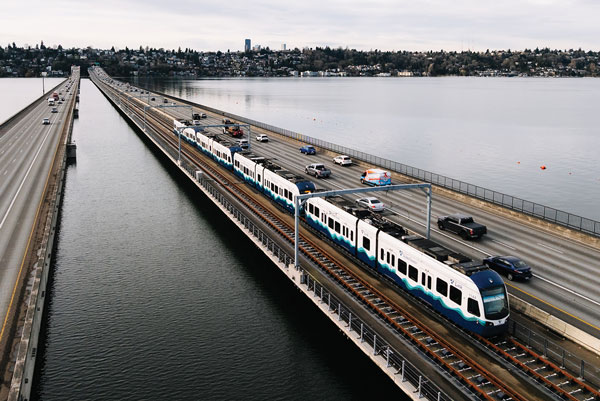
The Crosslake Connection is the world’s first light rail on a floating bridge and a means for fans to travel between Redmond and downtown Seattle. (Photograph courtesy of City of Redmond)
Given its proximity to the games, the city expects to see a significant boost in tourism.
“Our expectation is that our hotels will be full, and even if people go to the game, they will be spending time in and around Redmond when they’re staying here,” says Birney. “They might not stay in Redmond the whole time, but it’s going to be very busy.”
When people are really proud of the communities they live in, it makes them want to be more involved. I think you get back from your community when you invest like this.
– Angela Birney, Redmond Mayor
Redmond isn’t hosting any official FIFA-sanctioned events, but the city has been ramping up the World Cup spirit for months.
“I did want to make sure that our community was involved in whatever was going on, so in our last biennial city budget, I set aside money for World Cup activities,” says Birney.
One of those programs awards grants to help small businesses host watch parties. And it’s not just restaurants and bars applying for the grants. Several small, local organizations are planning watch parties that will feel safe for people who don’t want to cram into a rowdy bar. For example, one group is hosting a party for women to watch with their kids, while another is hosting a party for neurodivergent people so they can be in a comfortable space but still enjoy the experience of watching the game with a group.
The city is partnering with King County to host a big, family-friendly watch party in Marymoor Park for the final match of the tournament.
Redmond is also hosting the Fútbol for All Speaker Series, a wide-ranging series of talks with experts, in the months leading up to the tournament. Speakers have included former Sounders FC player James Riley, former Seattle Reign FC team captain Lauren “Lu” Barnes, and longtime sports broadcaster Jen Mueller. In an especially popular presentation, Sounders team photographer Corky Trewin taught people how to take better sports action shots, whether they’re at a Sounders match or capturing their kid’s gymnastics routine.
“The series has been really successful and a great educational opportunity for the community,” says Birney.
From her standpoint, making residents feel that their city is invested in big, international events and helping them feel a part of those events doesn’t just create a strong sense of community.
“When people are really proud of the communities they live in, it makes them want to be more involved,” says Birney. “I think you get back from your community when you invest like this.”