Special events leave an enduring mark on communities statewide.
Hosting a special event can be a major undertaking for a city or town, especially if it is a one-time occurrence. But even singular celebrations can leave a lasting mark on their communities—and continue to draw interest for decades to come.
One of Seattle’s most iconic landmarks, the Space Needle, was constructed for the 1962 World’s Fair (also known as the Century 21 Exposition). The 605-foot-tall tower’s unique design—essentially a flying saucer sitting atop a tripod base—reflected the fair’s focus on science and the space age. It was built in Seattle Center alongside several other still-existing structures, including the United States Science Pavilion (now Pacific Science Center) and the International Fountain. About 2.5 million people visited the Space Needle during the fair’s six-month run; today, it draws approximately 1 million visitors each year.
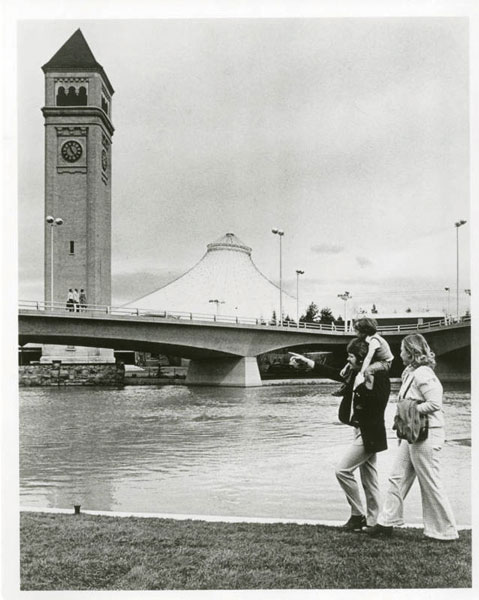
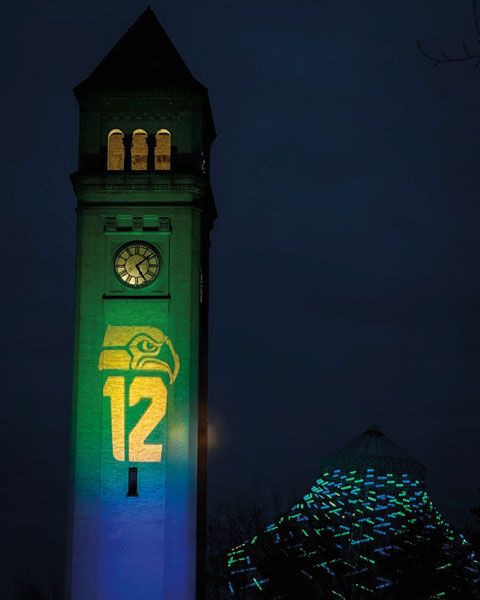
Spokane's Great Northern Clock Tower during Expo '74 (left) and earlier this year. (Images courtesy of Spokane Public Library (left) and Riverfront Spokane.)
On the other side of the state, Spokane revitalized its downtown in preparation for Expo ’74, the first world’s fair with an environmental theme. The event, which drew 5.6 million attendees, was held in what is now known as Riverfront Park. Buildings and attractions dating from the fair still stand today, including the Great Northern Clock Tower (all that remains of a train station that was demolished to make room for the exposition), the U.S. Pavilion (which was recently renovated), the Washington State Pavilion (now the Spokane Convention Center and the First Interstate Center for the Arts), and the Garbage Goat (a metal sculpture with a vacuum that allows visitors to “feed” it). More than 3 million people visit Riverfront Park each year.
Smaller-scale celebrations can also have an enduring impact on a city and strengthen community pride. Long Beach’s “World’s Largest Frying Pan” was commissioned for the first annual Long Beach Razor Clam Festival in 1941 and continues to be a popular roadside attraction (see “Going Big,” p. 6). Newport’s Centennial Plaza was built in 1989 to commemorate Washington’s 100th anniversary and is used today for local events, including the annual Christmas tree lighting. The value of hosting a special event—no matter its size—can extend far into the future.