Economic development guru Chris Mefford on forecasting sustainable growth.
By Kaya Williams
When it comes to community development, the conversation among residents, business owners, and local government might sound something like this: “‘We’re growing too quickly,’ or ‘We’re growing too slowly,’” says regional economist Chris Mefford, the founder, president, and CEO of Community Attributes Inc.
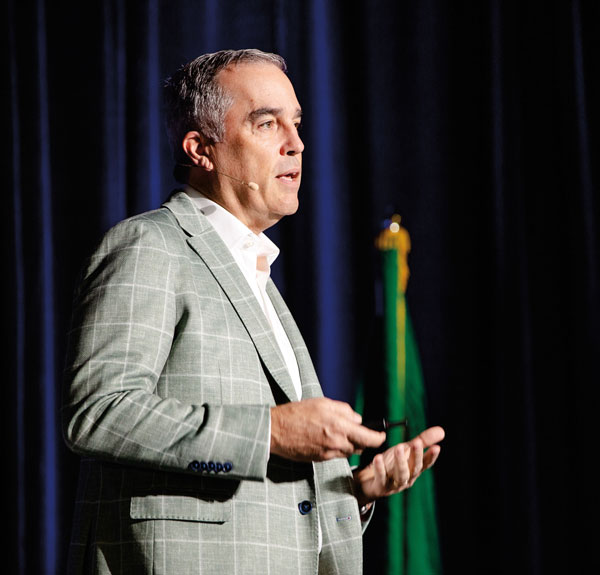
His Seattle-based community and economic development consulting firm works with cities around Washington state (and around the country) to ground those conversations in data. Mefford also helps local leaders interpret information to achieve their community’s vision and goals for the future.
“It’s a story every time,” says Mefford, noting that one city might be focused on downtown vitality while another prioritizes high-density housing. Here, he answers a few questions that should be top of mind for growth-oriented local leaders.
When cities are trying to boost their economic development, is there a hierarchy of what they should focus on?
We have a pyramid: The foundation of that is to be a good place. Are your neighborhoods safe? Are there good schools? Is the environment well taken care of? The second tier of that pyramid is for cities to take stock of their local economy and help businesses and workers thrive. Business climate, local tax policies, and access to training and education all come into play. When you get into business attraction [the third tier], we view that as a rather long-odds game. I do think it is a useful area to invest in. Cities should go after what they want. But the sure bet is to work with the businesses that are already there.
If a city official wants to get a better understanding of how the economy is impacting their revenue sources, what’s your recommended approach?
I want cities to always boil it down to the source of their revenues, and in Washington state, the two greatest fiscal drivers are property values and sales transactions. To a lesser extent, there’s also business income taxes. So, how do the businesses thrive? How are sales playing out in my community, and what’s the value of the land and the property in my city?
We’re in an interesting time for the economy. What’s the snapshot right now for the state of Washington?
Washington has something going for it that many states across the country just don’t have, which is that people want to move here all the time. With that comes a lot of sustainable growth. Washington [also] has a very well-diversified economy, and that will serve the state very well, even while the nation goes through some turmoil when it comes to tariffs and trade. Those are super important to the overall economy and the individual industries, but when you blend it all together across the state, we would expect Washington to fare far better than most.
When it comes to economic forecasts, what data should decision-makers pay attention to?
I think city leaders have to start by understanding their region and the city’s role. There are also other metrics [like] jobs-to-housing-unit ratio, and benchmarking that against the region as a whole. You can then understand the degree to which you’re a bedroom community versus an employment center. The regional economy will rise and fall on its own volition, and cities need to understand how to participate in that [and understand] their local strengths.
This interview has been edited and condensed.
For more information: communityattributes.com.