Lake Stevens Mayor and AWC Board Member Brett Gailey leverages a career in military service and law enforcement to bring efficiency and accountability to local governments.
Interview by Jen Krazit
What brought you to Lake Stevens?
I’ve lived in the Lake Stevens area since 2004, when I moved from Idaho with my family. My wife, Micah, is a CPA for a hospital. I have what I call two “batches” of children: my five older kids, ages 20 to 31, and my two youngest, who are 3 and 4 years old.

Lake Stevens Mayor Brett Gailey (Photo by Chona Kasinger)
What did you do before you became an elected official?
I joined the Army early in life and later served a church mission in the Dominican Republic. When I returned, I attended Boise State University and earned a degree in Spanish literature. I began my law enforcement career in 1998 with the Boise Police Department, and in 2004 I joined the Everett Police Department.
Alongside my police work, I served in the Idaho National Guard until about 2014, completing two tours in Iraq. I then transferred to the U.S. Army Reserve as a military intelligence officer, serving in assignments that took me to Japan and Florida. My final posting was commanding a small unit at Joint Base Lewis-McChord. I retired from the Army Reserve in June 2025.
You became mayor in 2020 and were on city council before that. Why did you decide to run for public office?
I like to joke that the “gateway drug” to politics is serving as your neighborhood HOA president—and that’s where it started for me. My career has always been about building community solutions, and the military taught me leadership. When progress stalled on a park project in my neighborhood, I decided to get involved. I joined the city’s planning commission, then ran for and won a seat on the city council. In 2020, after 21 years in law enforcement, I retired from the police department. When the previous mayor chose not to seek re-election, I ran for the office and won. The city council later made the role a full-time position.
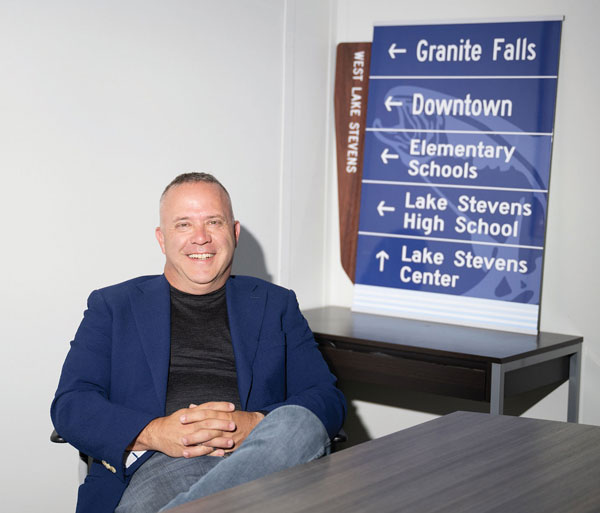
Mayor Gailey in his office at Lake Stevens City Hall. (Photo by Chona Kasinger)
“We changed the culture within our city, because now there’s a process of accountability with our systems.”
You joined the AWC Board of Directors last year. What made you decide to get involved with AWC?
Being a full-time mayor made me want to engage with organizations larger than my own city. AWC was a natural fit—every city in Washington is a member, from the biggest metro to the smallest town. I wanted to be part of a group that represents all of them.
What do you hope to achieve as AWC Board member?
One of my ongoing focuses is AI and technology—specifically how they can improve organizational efficiency. Larger cities often have the resources to research and implement new systems, but smaller cities don’t. I want to help AWC identify and share innovations that can make local government more efficient statewide, particularly for those smaller cities that need the tools but lack the bandwidth to find and deploy them.
Last year Lake Stevens won accreditation with the American Public Works Association. How did that come about?
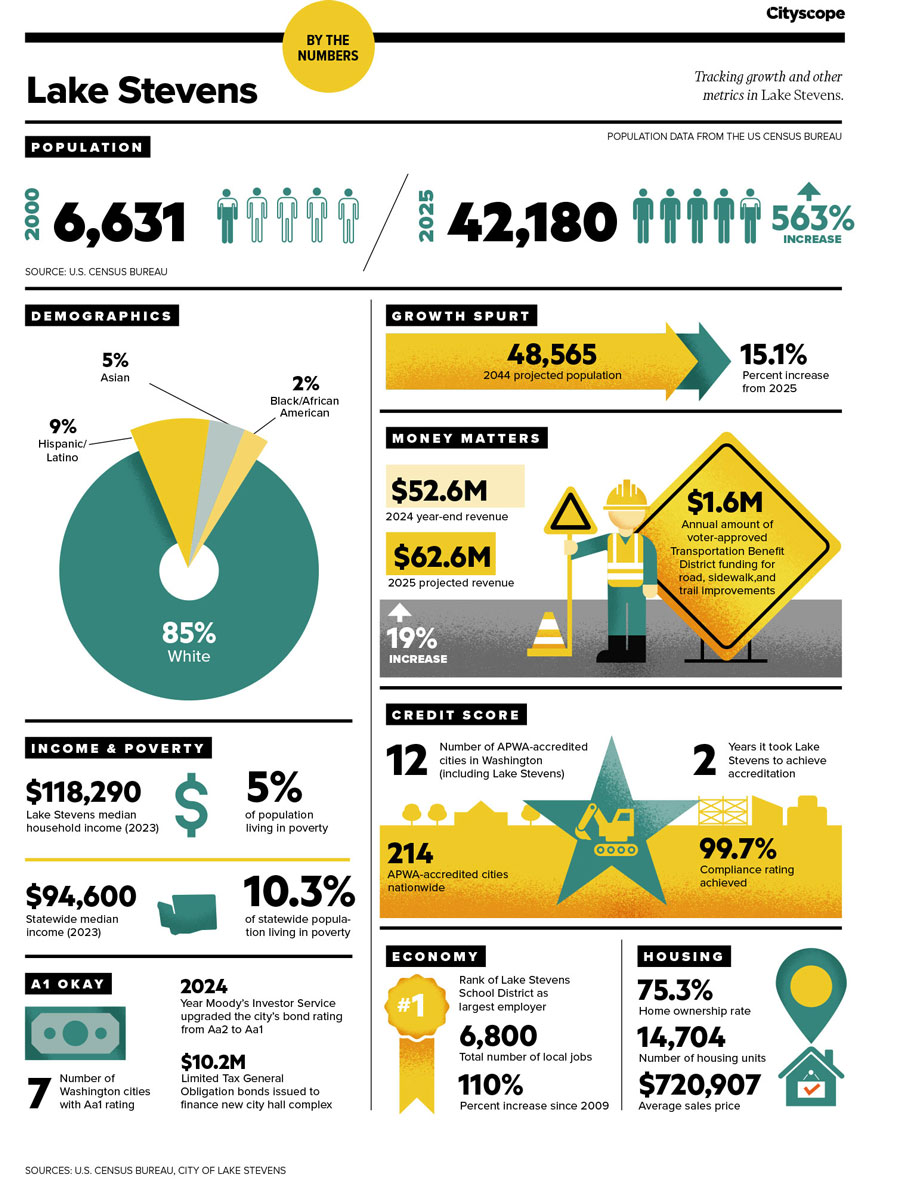
As a retired police officer, I realized I didn’t fully understand city operations from an administrative perspective. At an APWA conference, I learned about their accreditation program—a detailed set of best practices for municipal operations. At first, we weren’t even ready to begin. Our policies and procedures were scattered across various shared drives— or sitting in dusty binders. It took a year just to organize ourselves enough to start the accreditation process, and two years to complete it. It may not be glamorous, but I consider it one of my proudest accomplishments.
What does the APWA accreditation mean for the city?
Lake Stevens is one of only seven cities in Washington— and 214 nationwide—with this accreditation. It required us to get our policies and procedures in order not just in public works, but in all the supporting departments like HR, finance, and administration. The results have been tangible: improved customer service, a culture of accountability, and, unexpectedly, a bond rating upgrade from Aa2 to Aa1 by Moody’s. They recognized the improvement and standardization in our policies, which ultimately saved the city money by lowering borrowing costs.