Facing a multimillion-dollar shortfall, Yakima revamps its budget process to engender public trust and establish a solid financial foundation for its future.
Story by Jennifer Krazit
Hoping to address a long-simmering budget shortfall, the Yakima city council agreed in July to ask voters to approve a $6 million tax increase, with $3 million in targeted cuts. It’s a bold ask, but one that could work based on data gleaned from a yearlong outreach effort to educate the public about the city’s budget woes and get their input on prioritizing what services to cut or preserve.
The decision to put the proposed levy on the November ballot—and the sustainable budget it’s designed to support—followed a marked change in the way the city creates its biennial budgets. This budget cycle, the city has embraced a priority-based budgeting process and solicited a great deal of public input. The move is an effort to build public trust and establish a more sustainable budget for the future as the city works to resolve a $9 million deficit.
Building a sustainable budget
At the center of this effort are Yakima City Manager Vicki Baker and financial services consultant Mike Bailey. Baker was hired as city manager in August 2024 to help the city navigate the thorny process of righting a budget that had been problematic for years. Together they’re working to implement significant changes to the way Yakima’s budget is drafted.
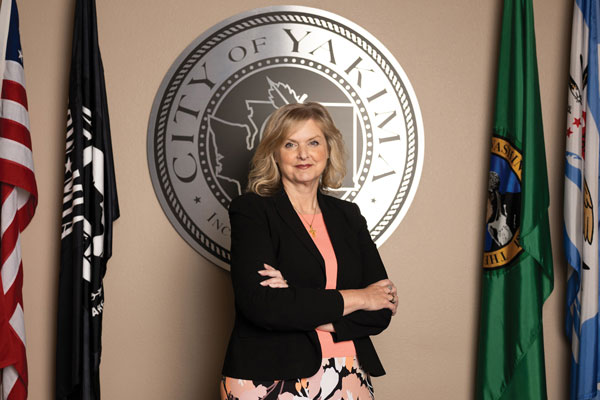
Yakima City Manager Vicki Baker (Photo by Chona Kasinger)
Last summer, Yakima’s city council members went on a daylong retreat at the Yakima Convention Center to develop the broad community goals that would guide the upcoming budget process. Foremost among the strategic priorities they identified was a desire to build a resilient community. That meant streamlining city processes, adopting new budgeting processes, and building a sustainable budget—and the matter was urgent.
The budget the city council had adopted in December 2024 included a $9 million shortfall that meant the city would need to tap into its reserves by the second year of the budget cycle. And this wasn’t an anomaly. Yakima’s previous budget had been in the red by a similar margin, which the city addressed by making cuts and using funds from the American Rescue Plan Act.
This summer, as it prepared for the 2026 budget cycle, with economic conditions worsening and no easy way to raise new funds, the city knew it needed to make some changes.
“We have structural problems with the 1% cap on property tax,” says Baker, referring to the statewide law that limits tax increases by taxing districts to 1% annually. “We also have inflation hitting at the same time that federal money is drying up. The city has been cutting for 24 years, and there’s not a lot of fat, so this is going to be really rough.”
“We have a structural problem with the 1% cap on property tax ... the city has been cutting for 24 years and there’s not a lot of fat.”
Setting priorities
One way the city council decided to approach the issue is by implementing priority-based budgeting, a process that’s growing in popularity among Washington municipalities. To help pull off the transition, they relied on Mike Bailey. As a consultant specializing in priority-based budgeting, Bailey has decades of experience helping cities across the state streamline budgets and solve other problems, most recently as director of finance and IT for the city of Redmond, with previous stints in similar roles in Renton, Lynnwood, Everett, Wenatchee, and Tacoma.
“To me, the worst thing I could do was not communicate the magnitude of the situation. ... I want people to go in with their eyes open and make an informed decision.”
– Vicki Baker
With a traditional budgeting process, governments start by rolling forward the current budget, estimating the next year’s revenues, and comparing the two to see how the math looks. “Increasingly, it looks dismal,” says Bailey. “So cities cut the budget, try to find efficiencies and leverage partnerships, which they should always be doing. But all those sorts of things have been done over the years and now the things left to cut are actual people who provide services.”
By contrast, priority-based budgeting begins by setting strategic priorities, ranking individual programs and services by how they align with those priorities and how well they perform, then allocating funding accordingly.
In other words, according to Bailey, “It’s not about asking ‘What are we doing today, and what does that cost?’
Priority-based budgeting puts off that question and starts with ‘What should we be doing?’” And, notes Bailey, it can be particularly useful in times of scarcity, when revenues are flat or declining but costs are on the rise—conditions that Yakima and many other Washington cities face today.
The process begins by identifying high-level, essential services a city provides, such as public safety, infrastructure, and economic development, and also might include nonessential services that nevertheless are deemed mission critical, such as parks and recreation. The city then lists assets, programs, services, and amenities offered under each category, along with costs for every item.
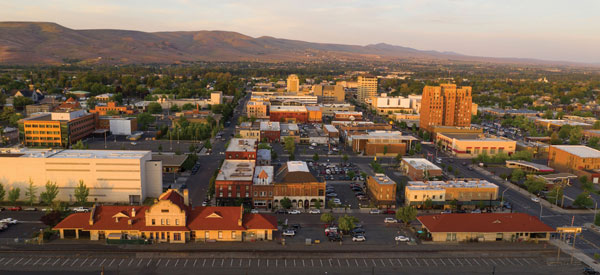
Downtown Yakima (Photo courtesy Shutterstock)
For example, under the category of public safety, a city might list all its police precincts then, for each, list the staff and specialty services provided at that location, such as a narcotics unit, a property crimes unit, a canine unit, or a jail. Ditto for firehouses. For parks and recreation, the list might include every swimming pool, gymnasium, municipal park, and field house, along with specific programs and services offered at each of those facilities.
The result is a grid, with service categories at the top, followed by a list of all associated programs that can be ranked from top to bottom according to priority.
40% of residents deemed police spending to be their top priority, followed by street maintenance and infrastructure (26%), parks and recreation amenities (25%), and fire protection (9%).
Inventorying the type and cost of every service a city provides might seem like a simple exercise, but once the grid is built, prioritizing the items in the grid requires a great deal of work, collaboration, and sometimes painful decisions.
“One of the challenges is that it forces you to say that not everything’s equally important, and you have to get your head around the fact that the city can’t do everything,” says Bailey. “If everything can’t be equally important, we have to stratify these programs as they relate to what our strategic plan said was important when we developed it, and then allocate dollars against those priorities, starting at the top, across the spectrum, and working our way down.”
As they work their way down the grid, most cities will run out of money before they run out of programs. At that point, a decision must be made, cutting one program in order to fund another, or possibly eliminating a category altogether. Another option: adjusting the revenue side of the equation by levying taxes or raising user fees.
“The question of how much money should be put to work—in other words, how high should taxes be, how high should fees be—is intrinsic to this process,” says Bailey. “Once you’ve allocated what you expect to have and you see where that leaves you in terms of funding programs at one level or another, then you can go back and ask the question of whether your resources are adequate to meet the needs of the community.”
Public education
Critical to implementing priority-based budgeting successfully, according to Bailey, is getting input from all stakeholders. That means department heads, employee committees, elected officials, and community members.
In Yakima, getting that public input took many forms, including conducting public surveys, holding town halls and community meetings, forming a community-led budget committee—all intended to get the word out to as many people across the community as possible.
“To me, the worst thing I could do is not communicate the magnitude of the situation,” says City Manager Baker, adding that instead, she opted to “tell people with honesty about the situation we’re in so they understand what’s at stake and what will happen.” For her, the public meetings were as much about getting people properly informed ahead of November’s levy vote as they were about resetting expectations of the programs and services Yakima can afford to provide.
“I want people to go in with their eyes open and make an informed decision, and if they say no [to the levy], we’ll implement their decision,” says Baker. “If we’re going to reduce the city’s services by $9 million, expectations are going to need to change.”
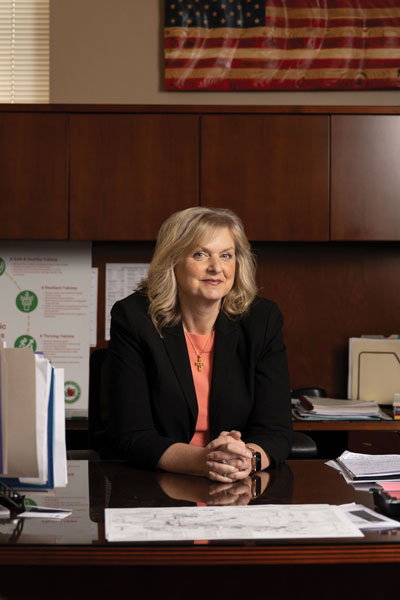
Yakima City Manager Vicki Baker in her office. (Photo by Chona Kasinger)
Despite the fact that the budget had been problematic for several years, the issue seemed to fly under most people’s radar. So Baker put together a presentation informing people about the budget gap, sharing the history and structure of the budget, and explaining what types of programs are included in the general fund and therefore could potentially be affected by budget cuts. Then she took that presentation on the road, speaking in front of Rotary and Kiwanis clubs and other organizations. “I did every public meeting I could get a hold of for months, wherever there was a group who wanted to hear it,” she says.
That also included three town halls, each one paired up with a couple of councilmembers and held in the neighborhoods they represent. At each meeting, Baker spoke for about 30 minutes, then took questions from the audience—residents who showed up in droves to advocate for maintaining a popular senior community center, public safety, youth programs, and economic development. At one session, questions went on for more than two hours.
Meanwhile, Mike Bailey spent three months working directly with a community budget committee consisting of seven finance-minded residents who’d been nominated by city council members. Bailey quickly schooled the group about the basics of government budgeting and facilitated exercises so they could make their own set of recommendations to the city council about how programs should be ranked and what potential tax increases might look like.
Surveying the city
Another key facet of the city’s public outreach effort was a three-question survey. The survey asked for people’s top priority for the city budget and whether they would support increasing property taxes to pay for police, fire, and court services. It also included a tool people could use to see the actual cost of about 35 programs that come out of the general fund and could potentially be on a cut list in the future. Individuals could select what they thought should be cut, and the tool updated their total in real time as they ticked different boxes and tried to reach $9 million in cuts.
The survey was posted to the city’s website and social media accounts, where it got strong engagement. Baker encouraged people at all of those public meetings to fill out the survey. She also took it to grocery stores, sporting events, and festivals—wherever large groups of people could be found—sharing a QR code linked to the survey and soliciting people’s input. In the end, more than 2,000 residents, mostly from the city’s west side, completed the survey. The results: 40% deemed police spending to be their top priority, followed by street maintenance and infrastructure (26%), parks and recreation amenities (25%), and fire protection (9%).
Direct feedback like this gave Baker important insight into the programs community members valued most. Topping the list of priorities to fund were police programs like a gang unit and a narcotics unit, a fire station and firefighters, and a senior center. The top items to cut included city council travel and lobbying, and economic development-related programs like summer flower baskets that hang downtown and Fourth of July fireworks. Results also indicated that simply knowing what’s at stake (i.e., what programs might be lost if the city can’t increase revenue) might sway some people’s opinions come November. Yakima residents tend to be politically conservative and anti-tax, according to Baker. In response to the survey’s second question (“Would you support increasing property taxes to specifically pay for police, fire, and court services?”), about 40% of respondents said yes. When a similar question was asked after people participated in the city’s priority-based budgeting exercise (“If property taxes were raised by about $20 a month for the average home-
owner, public safety services would be fully funded. Knowing that, how do you feel about increasing taxes to support police, fire, and court services?”), 57% of respondents answered “yes.”
All of this information helped shape the final recommendations Baker gave to the city council about how to address the city’s looming $9 million budget shortfall. And because of the work she and Bailey did upfront, those recommendations came with data, not just a few people’s opinions. This gave the council the courage (backed by information) it needed to decide, by a vote of 4 to 3, to place a $6 million tax increase referendum on the November ballot to fund the services residents—who would on average pay an additional $178 per year—deemed a priority. And to cut the $3 million needed to balance the budget from services the community deemed expendable, which included reducing operational hours at the city’s indoor swimming pool, and mothballing one of its outdoor swimming pools during the summer of 2026.
A more transparent budget
Both Bailey and Baker will tell you priority-based budgeting doesn’t make things easier. But it does make a city’s budget more transparent to the public, and it can give communities insight into the tight-rope act of balancing a city’s budget. All of that hopefully leads to more informed decisions as cities make tough budgeting choices and as residents evaluate ballot initiatives.
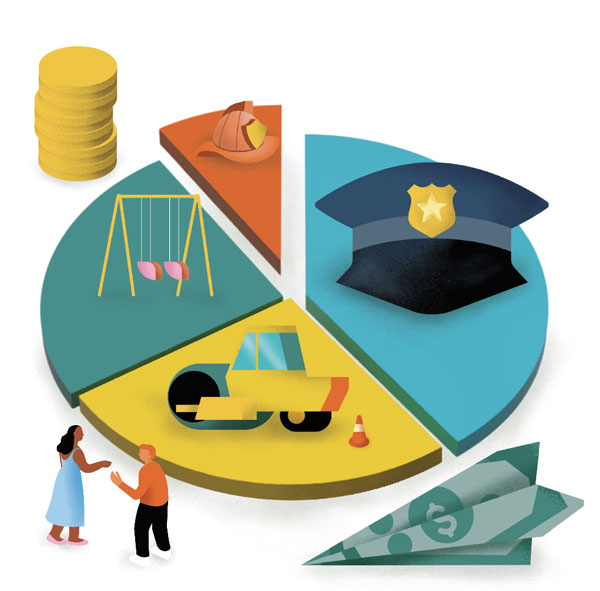
Illustration by Nate Bullis
“One of the criticisms I have heard is that priority-based budgeting is a lot of work, and I won’t argue that,” says Bailey. “That’s because it’s more than just creating a budget. As a finance director, I could go in the back room with the mayor and create a budget, and that would be easy to do, but that’s not meeting the best needs of my community.”
For striving to do the opposite, Vicki Baker credits the city council.
“I am so proud of them for having the courage to dive into a challenging budget issue,” she says, “And to do so with transparency.”
As for Yakima, the benefits of this new budget process will bear out over the coming months and years.
“I really don’t know where we’re going to end up,” says Baker. “Three years from now—after we’ve become more mature in priority-based budgeting and everything that we care about is funded and we’ve reduced the things that we couldn’t afford—we’ll see if we really did get to that goal of having a more sustainable budget.”
In the meantime, she says she feels good about the process Yakima has gone through and grown through. “I feel very confident that we have done our best to have our community be aware of the situation that we’re in.”