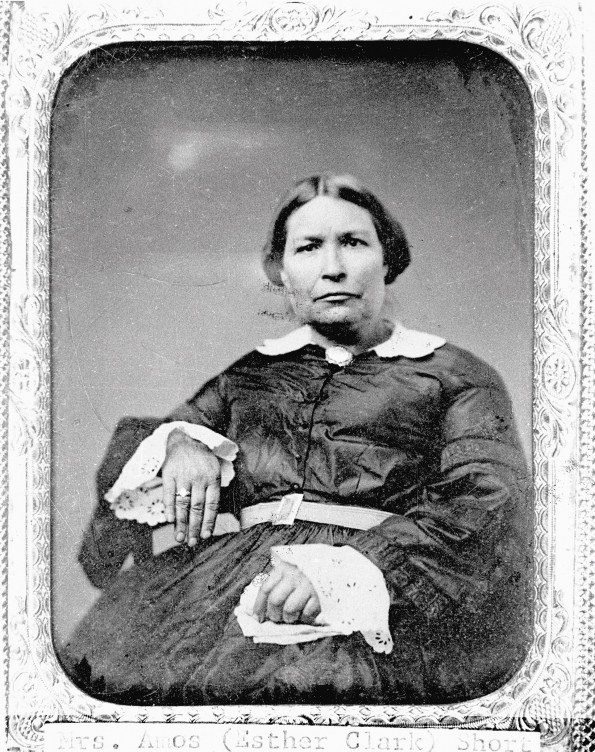
Remembering Esther Short, a 19th-century trailblazer who foresaw the civic landscape-altering potential of public spaces.
On Christmas Day 1845, Esther Clark Short, her husband Amos, and their nine young children arrived by wagon train at the end of the trail in Oregon Territory and built a homestead near Fort Vancouver. Over the next eight years, the Shorts defied many attempts by the Hudson’s Bay Company to evict the American settlers: once, while Amos was away, soldiers from the fort set Esther and her children adrift on a raft in the Columbia River; on another occasion, when a company of French-Canadian soldiers attempted to drive the family across the river to Oregon, the feisty matriarch stood her ground and knocked their commanding officer off his feet.
Ultimately, the Shorts prevailed. With the passage of the Land Claim Act of 1853, the year her husband died, Esther Short was granted 640 acres at the heart of present-day Vancouver. She established the city’s first restaurant in 1853, the first hotel in 1854, and the first park in 1855, donating a five-acre parcel as a public square that still bears her name.
Esther Short Park—Washington’s oldest municipal park—serves as a model civic gathering space. It draws young and old year-round with a covered performance pavilion, a Victorian rose garden, an interactive water feature, a bell tower and glockenspiel, and (dedicated in 2023) the city’s first fully inclusive playground—a pilot program called Project Play that is being replicated across the city, and around the state.
“The City of Vancouver has a really amazing vision for what the future will look like,” says Jeremy Robbins, a disability educator who serves on the Vancouver Parks and Recreation Advisory Commission.
A vision firmly rooted in the past, with the Pioneer Mother—a life-sized bronze of the park’s namesake, flanked by a passel of children—standing as a sentinel at the center of the plaza, watching over it all.